
- FDA 21 CFR Part 1271: Reproductive tissues shipped across state lines must comply with human cells, tissues, and cellular and tissue-based products (HCT/P) regulations, requiring donor eligibility documentation and chain-of-custody records.
- IATA Special Provision A152: Governs the air transport of biological substances in cryogenic containers — only dry shippers with approved vapor-phase nitrogen are permitted in passenger cabins.
- 2026 Updates: New FDA guidance now mandates electronic chain-of-custody records for interstate HCT/P shipments, replacing paper-only documentation.
- Dual Compliance Required: Any legitimate IVF courier must simultaneously satisfy both domestic FDA regulations and international IATA standards — gaps in either framework create legal and medical risk.
Understanding FDA 21 CFR Part 1271: The Domestic Framework
In the United States, frozen embryos, eggs, and sperm are classified as Human Cells, Tissues, and Cellular and Tissue-Based Products (HCT/Ps) under FDA authority. Title 21, Code of Federal Regulations Part 1271 establishes the regulatory requirements that govern their handling, storage, and transport between facilities.
- Donor Eligibility Documentation: The sending clinic must provide a complete donor eligibility determination package — including communicable disease testing records — that accompanies every shipment. Receiving facilities cannot accept HCT/Ps without this documentation.
- Establishment Registration: Any entity that processes, stores, or distributes HCT/Ps — including specialized IVF couriers who temporarily hold specimens — must be registered with the FDA as an HCT/P establishment.
- Current Good Tissue Practice (cGTP): All handling must adhere to cGTP standards, which address personnel qualifications, facilities, equipment calibration, and comprehensive recordkeeping throughout the transport chain.
- Chain-of-Custody Records: As of 2026, the FDA requires electronic chain-of-custody documentation for all interstate HCT/P shipments. Paper-only systems are no longer compliant for cross-state transfers.
Non-compliance with 21 CFR Part 1271 can result in FDA warning letters, seizure of specimens, and prohibition from receiving future shipments — risks no clinic or patient should accept from an under-qualified courier.

IATA Special Provision A152: The International Air Transport Standard
The International Air Transport Association (IATA) governs the safe carriage of dangerous goods and biological substances aboard commercial aircraft. For IVF specimen transport, the critical framework is Special Provision A152, which addresses the carriage of biological substances in cryogenic containers.
Approved Container Types
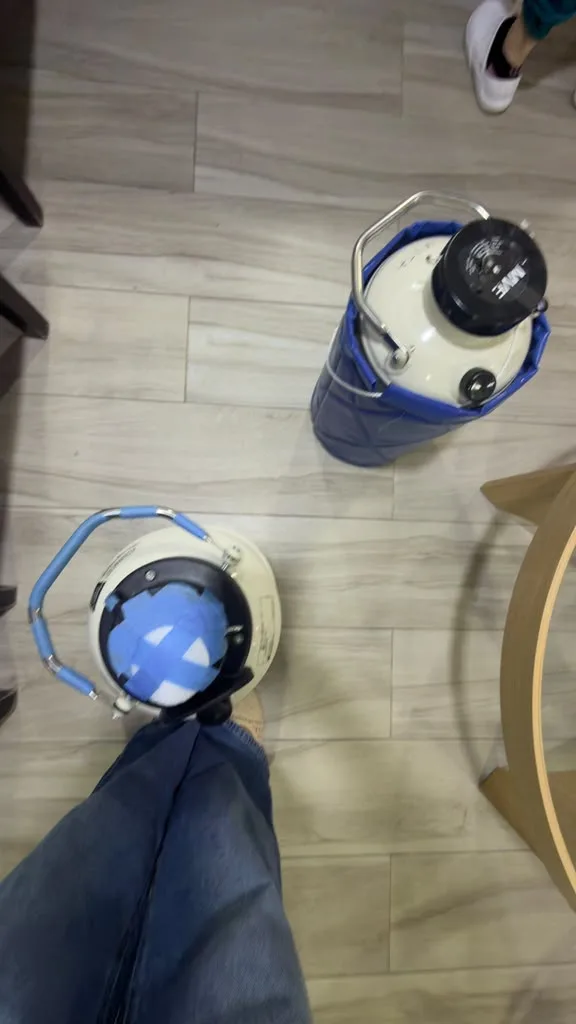
Only dry shippers using vapor-phase liquid nitrogen — not wet liquid nitrogen — are permitted aboard passenger aircraft. IATA A152 specifies absorption material requirements that prevent free-liquid spills under any orientation.
Shipper's Declarations
Couriers must carry completed IATA Shipper's Declaration for Dangerous Goods forms at all times — properly classified under UN 3373 (Biological Substance, Category B) or appropriate exemption documentation.
Airline Pre-Authorization
Each airline requires advance notification and approval for cryogenic biological substances aboard. This clearance must be secured before departure — not at the gate.
Security Screening Protocol
IATA guidelines specify that dry shippers must not pass through X-ray screening. Couriers must present documentation requesting manual inspection to protect specimen integrity.
2026 Regulatory Updates: What Changed This Year
The regulatory landscape for reproductive tissue transport evolved meaningfully in 2026, with changes that affect both domestic and international shipments:
Electronic Chain-of-Custody (FDA)
Paper-only documentation no longer satisfies FDA requirements for interstate HCT/P shipments. Clinics must implement or partner with couriers who provide fully digital, time-stamped custody records and milestone status updates at each critical phase.
IATA 65th Edition Updates
The 2026 edition of IATA regulations tightened documentation requirements for biological specimens crossing international borders, requiring country-specific import/export permits to be pre-verified rather than assumed.
TSA Enhanced Screening Protocols
Updated TSA guidance clarifies that hand-carry medical cryogenic shippers require coordination with airline medical desks prior to security screening to ensure specimens bypass ionizing radiation equipment.
International Import Permit Pre-Verification
Several destination countries strengthened their advance-permit requirements for biological tissue import in 2026, requiring permit numbers on air waybills before the aircraft lands — not at customs clearance.
How Geld IVF Courier Maintains Full Dual Compliance
Meeting both FDA and IATA requirements simultaneously demands dedicated institutional knowledge, not improvisation. Our compliance framework is built into every shipment:
- FDA-Registered Operations: Geld IVF Courier maintains active FDA HCT/P establishment registration, ensuring every shipment moves through a legally recognized facility at every stage.
- Electronic Custody Platform: Our proprietary chain-of-custody system provides verified digital documentation with milestone status updates accessible to sending and receiving clinics, satisfying 2026 FDA electronic recordkeeping requirements.
- Pre-Cleared Airline Authorizations: We maintain standing pre-authorizations with major carriers operating on our primary routes, eliminating gate-day surprises for cryogenic specimen transport.
- Country-Specific Import Intelligence: Our regulatory database tracks destination-country permit requirements updated quarterly, ensuring no shipment arrives without advance-verified import clearance.
- Trained Compliance Couriers: Every courier undergoes IATA Dangerous Goods training specific to Category B biological substances and receives FDA cGTP orientation before handling any specimen.
Frequently Asked Questions
-
Does an IVF courier need FDA registration to transport embryos?
Yes. Any entity that transports human reproductive tissue — including embryos, eggs, and sperm — between states or internationally is subject to FDA regulation under 21 CFR Part 1271, which governs Human Cells, Tissues, and Cellular and Tissue-Based Products (HCT/Ps). A compliant courier must maintain an active FDA HCT/P establishment registration, verifiable on the FDA's public registry.
-
What is IATA Special Provision A152 for reproductive specimens?
IATA Special Provision A152 governs the air transport of human specimens including cryopreserved reproductive material. It classifies these as Category B biological substances (UN 3373) and requires specific packaging, labeling, and accompanying documentation. Couriers handling IVF specimens must hold current IATA Dangerous Goods certification to legally carry specimens on commercial flights.
-
What documents are required to transport embryos across international borders?
Required documentation typically includes: (1) FDA chain-of-custody records; (2) IATA UN 3373 packaging certification and dangerous goods declaration; (3) a specimen manifest with patient consent verification; (4) sending clinic's embryo release paperwork; and (5) destination country-specific import permits where required (e.g., COFEPRIS for Mexico). Professional IVF couriers prepare and carry all documentation before departure.
-
Can a general freight courier legally transport frozen embryos?
Not legally without proper credentials. A general freight courier lacks FDA HCT/P establishment registration, IATA DG certification for biological substances, and the chain-of-custody documentation protocols required by federal regulation. Using an uncertified carrier exposes the sending clinic and patient to regulatory liability and risks that specimens will be seized, refused, or returned at customs.
Full Compliance. Zero Guesswork.
In a regulatory environment where gaps in either FDA or IATA compliance can halt your shipment at customs — or expose your clinic to enforcement action — choosing a fully certified IVF courier is not optional. It is the only responsible choice.
Request a Quote

